
From waste stream to measured diversion.
Waste audits, circularity strategy, and program design, instrumented by our AI-driven WASTEK platform. For organizations that want diversion they can measure and report, not bins they hope get sorted right.
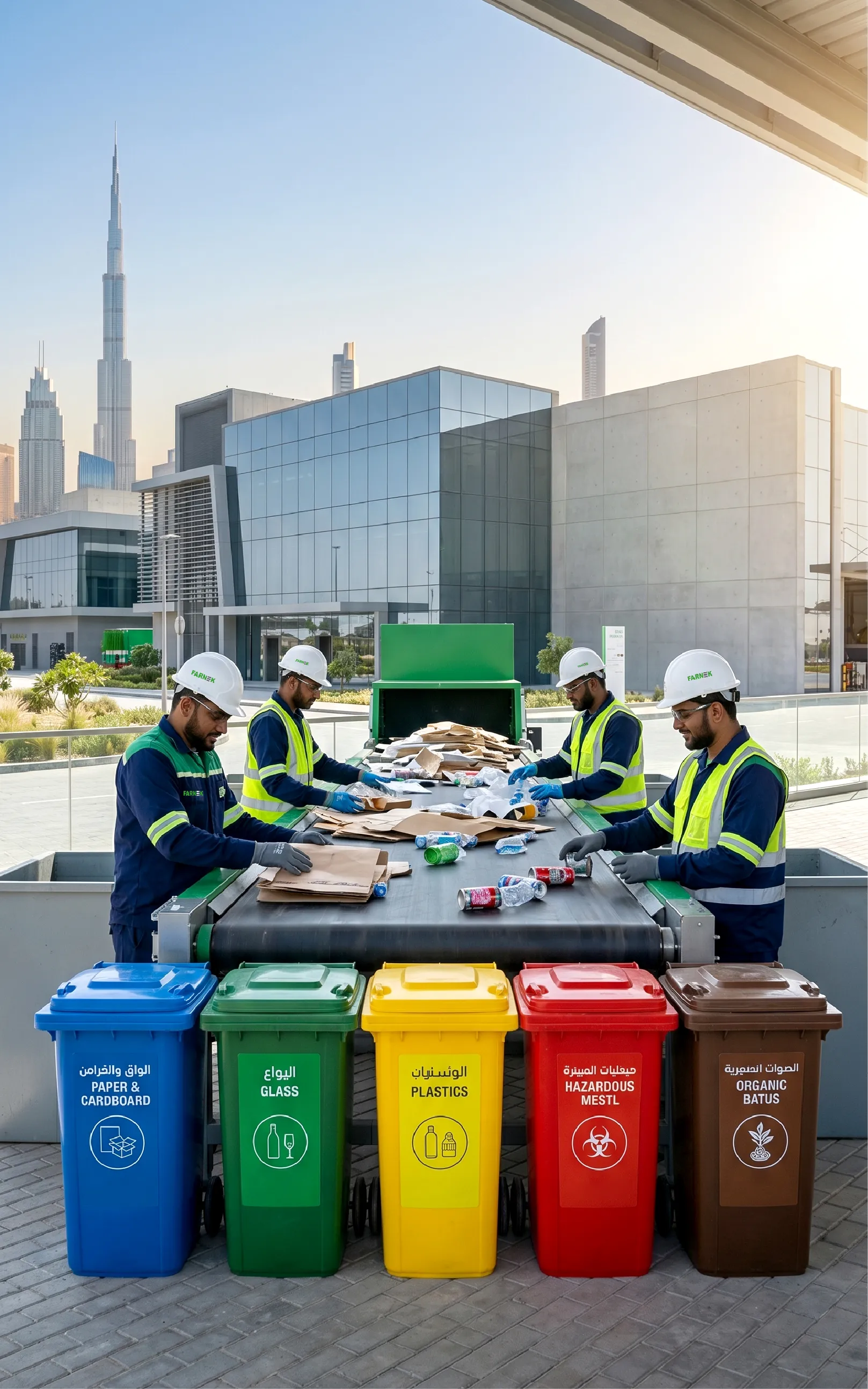
Diversion starts with data.
In the UAE, landfill gate fees and diversion targets are climbing, and waste sits squarely in Scope 3. Without precise data on what is generated and what is actually diverted, waste stays a cost and a compliance risk instead of a managed, reportable stream.
Most organizations cannot say what is in their waste, how much truly gets diverted, or whether segregation survives once the bins leave the floor. The opportunity, and the credibility, is in the measurement. That is the work we do.
Seven services. One number that holds.
Every engagement is built so the diversion rate is measured, not estimated: audited at the bin, tracked by stream, and reported to a standard your stakeholders accept.
Waste Audits
A site audit that measures what is actually thrown away. We collect and sort a representative sample, analyse composition by stream, and establish a baseline of generation and genuine diversion. The output is a number you can set targets against, not an estimate.
Includes site audit, data collection, composition analysis, baseline reportStrategy & Programs
Diversion goals, a waste management strategy, and an implementation roadmap that turns the audit findings into an operating program with owners and targets.
Circularity Advisory
Designing waste out earlier: reusable inputs, extended material life, and procurement choices that keep resources in use rather than in landfill.
Event Waste Management
On-ground waste operations for stadium and festival-scale events: trained green teams, color-coded segregation, and live tracking across zones.
Diversion & Recycling
Segregation systems and collection logistics across food, recyclables, general, and hazardous streams, designed around realistic diversion targets.
WASTEK Reporting
QR-coded data capture at the bin, dashboards by location, type, and period, automated audits, and ESG-aligned reporting from source to report.
TRUE Zero Waste Advisory
Advisory and pathway support toward TRUE zero waste certification, for organizations targeting 90 percent or higher diversion.
Four phases. Measured at the bin.
The methodology below structures every waste engagement. Phase 1 establishes what is in the waste and where it goes. Phases 2 to 4 scale to the size and ambition of the program.
-
Phase 01
Waste assessment audit
Measure what is actually generated. Conduct a site audit, collect and sort a representative sample, analyse the composition by stream, and review the data to establish a credible baseline of generation and diversion.
- Site audit and data collection
- Waste composition analysis by stream
- Data review and quality check
- Baseline report
-
Phase 02
Waste management plan
Turn the baseline into a plan. Set diversion goals, develop the waste management and circularity strategy, and define an implementation roadmap with owners, streams, and targets.
- Waste management goals development
- Strategy and circularity design
- Implementation roadmap
- Segregation and stream definition
-
Phase 03
Implementation
Put the program on the ground. Roll out segregation systems and signage, deploy trained green teams, organise collection logistics, and instrument the operation with WASTEK so every stream is captured at the point of disposal.
- Segregation systems and signage
- Trained green teams
- Collection logistics
- WASTEK deployment at the bin
-
Phase 04
Monitoring, reporting, and continuous improvement
Prove the result and improve it. Track diversion through WASTEK dashboards, produce automated audits and ESG-aligned reports, train the operating team, and refine the program as streams and volumes change.
- WASTEK monitoring and performance reporting
- Automated audits and ESG-aligned reporting
- Operator training
- Continuous improvement
WASTEK measures it at the bin.
Our AI-driven waste platform captures data at the point of disposal through QR-coded bins, builds dashboards by location, waste type, and period, and produces automated audits and ESG-aligned reports. Diversion becomes a number you can defend, not a claim you have to trust.
Explore WASTEKMeasured diversion at a stadium concert.
Coldplay · Music of the Spheres · Abu Dhabi · February 2025
For Coldplay's Abu Dhabi shows, Farnek ran the on-ground waste operations: WASTEK deployed across the venue, trained green teams, color-coded segregation, and real-time tracking across multiple zones, turning a stadium-scale event into a measured diversion result.
Measured, not estimated.
Audits, diversion rates, and reporting follow recognized standards and local regulations, so the numbers can be reviewed, compared, and disclosed with confidence.
Our team includes TRUE Advisors and ISO 14001 practitioners, and we report waste data in line with GRI 306.
- TRUE
- ISO
14001 - GRI
306 - Basel
- Tadweer
- Dubai
Municipality - EPR
- ZWIA
Questions decision-makers ask us.
Common questions from facilities and sustainability teams, event organizers, and operators building a waste program. If yours is not here, get in touch below.
What is a waste audit and what does it tell us?
A waste audit measures what an organisation actually throws away. We collect and sort a representative sample, analyse the composition by stream (food, recyclables, general, hazardous), and establish a baseline of how much is generated and how much is genuinely diverted from landfill. It turns assumptions into a number you can set targets against.
How is waste diversion rate calculated?
Diversion rate is the share of total waste, by weight, that is kept out of landfill through recycling, composting, reuse, or recovery. It is only credible if the weights are measured at the point of disposal rather than estimated, which is exactly what our WASTEK platform captures.
What is the difference between recycling and circularity?
Recycling deals with material after it becomes waste. Circularity designs the waste out earlier: choosing reusable inputs, extending product life, and keeping materials in use through procurement and process decisions. Recycling is one tool within a circular strategy, not the whole of it.
How does WASTEK capture waste data?
WASTEK captures data at the point of disposal using QR-coded bins. Staff scan, enter weights, and upload verification photos, and the platform builds dashboards by location, waste type, and time period, with automated audits and ESG-aligned reporting. The result is transparent, source-level data rather than monthly estimates.
Does waste fall under our carbon footprint?
Yes. Waste sits in Scope 3 of an organisation's carbon footprint, and landfilled organic waste in particular generates methane, a potent greenhouse gas. Improving diversion reduces both disposal cost and emissions, which is why we coordinate waste programs with our Carbon Management team.
What is TRUE certification?
TRUE (Total Resource Use and Efficiency) is a zero waste certification administered by GBCI. It recognises facilities that divert at least 90 percent of waste from landfill, incineration, and the environment, and that embed zero waste practices into operations. We provide advisory and pathway support toward TRUE.
Talk to our waste team.
A 30-minute consultation, no commitment. We walk through what is in your waste today, your diversion targets, and where the quickest wins are.